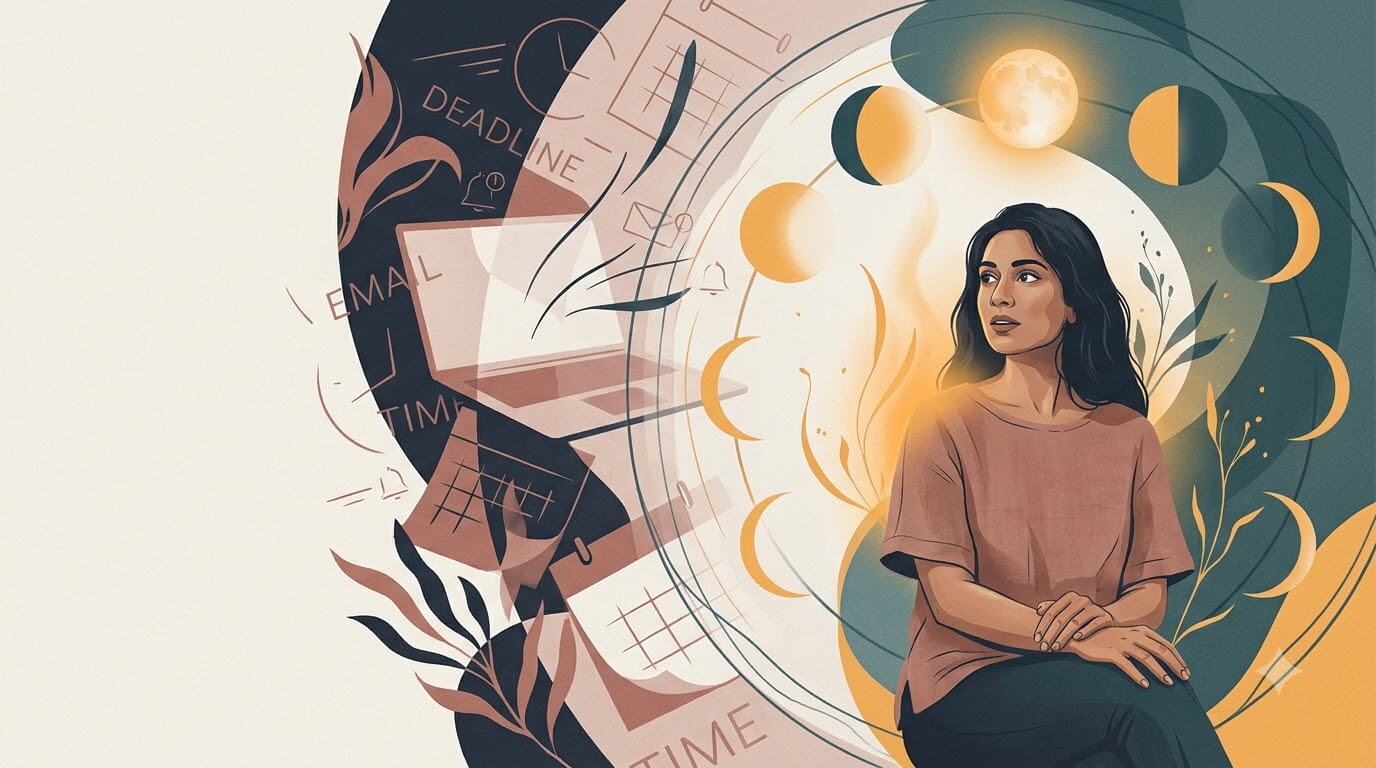
Perimenopause or Just Stress? How to Tell the Difference
Can't tell if it's perimenopause or stress? Learn the real differences — from cycle changes to cortisol — and when to see a doctor.
You're snapping at your kids over nothing. You're wide awake at 2 a.m. for the third night this week. You used to handle a packed calendar without blinking, and now one difficult email leaves you rattled for hours. So you ask the obvious question: is this just a stressful season of life, or is something else going on?
It's a fair question, and it's harder to answer than it should be. Perimenopause and chronic stress produce an almost identical list of symptoms — fatigue, brain fog, irritability, disrupted sleep, a shorter fuse than usual. Doctors themselves admit the overlap is genuinely confusing, not just a case of women "not knowing their own bodies." The good news is that once you know what to actually look for, telling the two apart gets a lot more manageable.
Why They Feel So Similar
Stress and perimenopause aren't unrelated conditions that happen to look alike by coincidence. They actually run through some of the same biological wiring.
When you're under pressure, your body releases cortisol, your main stress hormone. Cortisol is produced through a chain of communication between your brain and adrenal glands called the HPA axis. It's meant to be a short-term survival tool — useful for outrunning danger, less useful for surviving a Monday inbox.
Your menstrual cycle runs on a related but separate communication chain, called the HPO axis, connecting your brain to your ovaries. Here's the problem: these two systems don't operate in isolation. Research on functional hypothalamic amenorrhea — a condition where periods stop due to physical or emotional stress — has documented that elevated cortisol can directly interfere with the hormonal signals your ovaries depend on, according to Mayo Clinic OB-GYN research on menstrual changes in young women.
Cleveland Clinic OB-GYN Dr. Swapna Kollikonda puts it plainly: cortisol can disrupt the connection between your hypothalamus, pituitary gland, and ovaries, leading to delayed, lighter, or completely absent periods depending on how your individual body handles stress. Dr. Randa Jalloul, an OB-GYN at UT Physicians, adds that this hormonal disruption is essentially your body's way of signaling that now isn't a safe time for pregnancy — whether or not that's actually true for your life.
So when perimenopause is also underway, you get a kind of double disruption. Fluctuating estrogen already affects mood, sleep, and temperature regulation on its own. Add a stressful stretch of work or family life on top of that, and the two amplify each other rather than staying politely separate.
Signs That Point to Perimenopause
A few clues tend to show up more with hormonal shifts than with stress alone:
- Your cycle itself is changing. Periods arriving closer together, further apart, heavier, lighter, or skipping altogether — this is one of the clearest tells, because everyday stress rarely rewrites your cycle this dramatically on its own.
- Hot flashes or night sweats. Sudden heat and sweating, especially waking you specifically between 2 and 4 a.m., point toward hormones rather than a busy week.
- Vaginal dryness or a drop in libido. These are driven by declining estrogen, not by having too much on your plate.
- Symptoms show up regardless of your circumstances. If a genuinely relaxing weekend or a lighter week at work doesn't make you feel any better, that's a meaningful clue.
- It's happening in your late 30s or 40s. Timing isn't proof by itself, but it matters. This is worth underlining for Indian readers specifically: a PAN-India survey by the Indian Menopause Society found the average age of menopause here is 46.2 years — nearly five years earlier than the global average of 51 — which means perimenopause itself commonly begins in the late 30s for Indian women, not the mid-40s many assume (Ahuja, Journal of Mid-life Health, 2016).
Signs That Point to Stress
On the other side, a few patterns suggest stress is the bigger driver:
- Your cycle hasn't changed. Still regular, still predictable, still arriving roughly on schedule.
- No hot flashes, no night sweats, no vaginal changes. The absence of all three together is genuinely informative.
- You can trace it to something specific. A demanding project, a family crisis, a new job — the symptoms started around the same time as an identifiable pressure.
- It eases when the pressure lifts. Even a short break or a lighter week brings some real relief, not just a temporary distraction from it.
When It's Honestly Both
Here's the part most articles skip: for a lot of women in their late 30s and 40s, it isn't a clean either-or. A demanding season at work can hit right as perimenopause is quietly starting, and each one makes the other harder to spot. Chronic stress raises cortisol; fluctuating estrogen makes your nervous system more reactive to that same cortisol. Neither cause cancels the other out, and treating only one usually leaves you still feeling off.
This is exactly why guessing on your own has limits — not because your instincts are wrong, but because two overlapping causes need to be teased apart with actual information, not just a gut feeling on a bad day.
A Simple Way to Get Clarity
Before your next doctor's visit, spend two to three months jotting down three things: your cycle dates and flow, any hot flashes or night sweats, and a rough 1–5 mood and sleep score. You don't need a fancy app — a notes file works fine. Patterns that repeat with your cycle point toward hormones; patterns that repeat with your calendar point toward stress. Either way, you'll walk into that appointment with something far more useful to say than "I just don't feel like myself."
When to See a Doctor
Reach out sooner rather than later if you notice very heavy bleeding, bleeding after sex, chest pain, or persistent hopelessness that doesn't lift. And if you've been guessing between "stress" and "perimenopause" for more than a couple of months without any real answer, that alone is a good enough reason to book the appointment. You don't need to be certain before you go — that's what the visit is for.
References
- Cleveland Clinic — How Stress Can Impact Your Menstrual Cycle
- UT Physicians — How Stress Affects Your Menstrual Cycle
- Mayo Clinic News Network — Menstrual Cycle Changes in Young Women
- Ahuja, M. (2016). Age of Menopause and Determinants of Menopause Age: A PAN India Survey by IMS. Journal of Mid-life Health.
This article is educational and doesn't replace advice from your own doctor. If your symptoms are affecting your daily life, please see a gynaecologist.
Keep Reading
Two more reads from the Journal, thoughtfully chosen to continue from here.
 Perimenopause
16 September 2026
Perimenopause and Anxiety: Is It Hormones or Something Else?
New anxiety in your 40s? Learn the real hormonal mechanism behind perimenopausal anxiety — and how to tell it apart from an anxiety disorder.
Read more Perimenopause
6 September 2026
Perimenopause vs PCOS: How to Tell Them Apart After 35
PCOS and perimenopause share symptoms like irregular periods and weight gain. Learn the real differences and why confusion peaks after 35
Read more