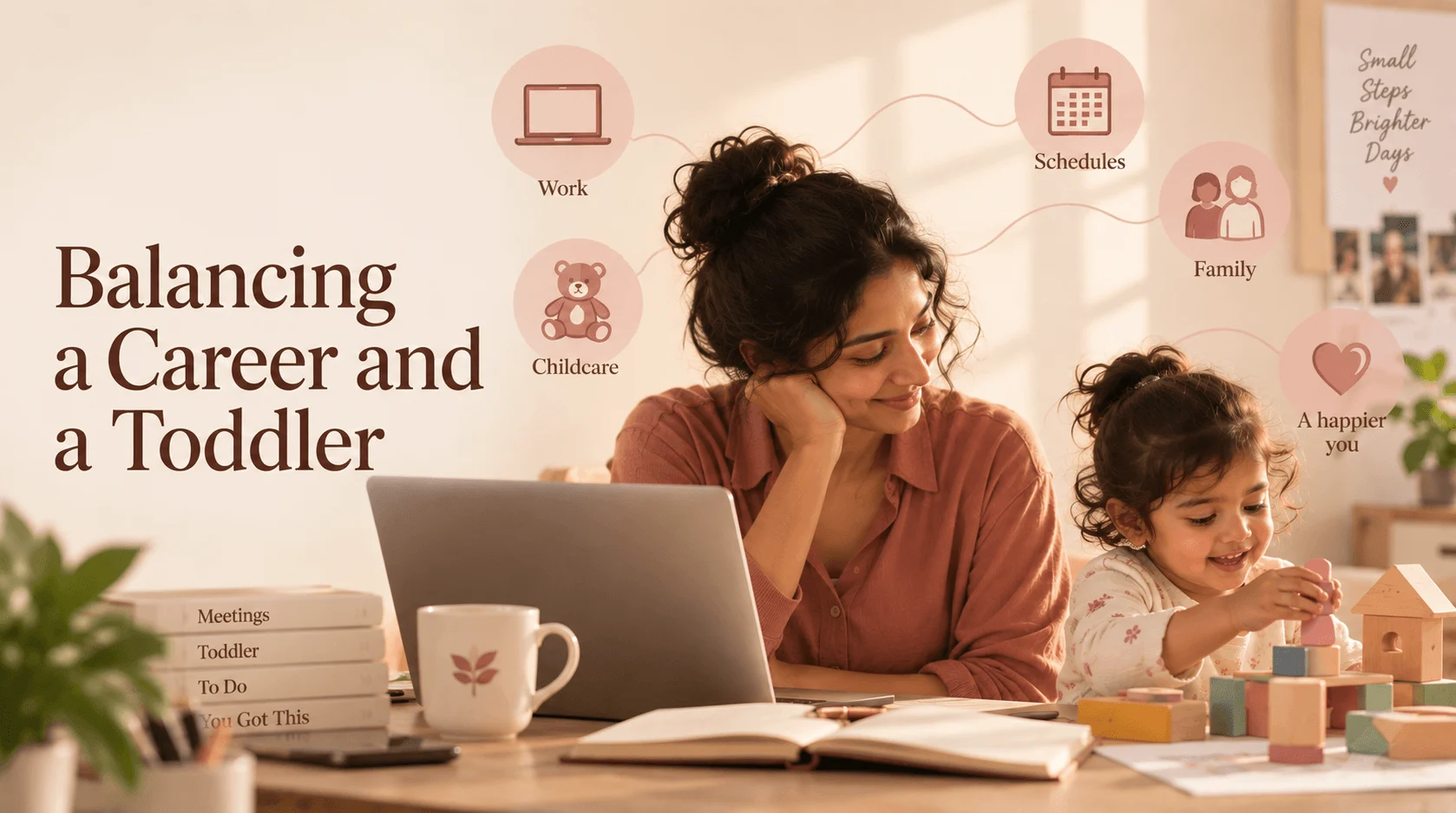
Working Mothers in India: Balancing a Career and a Toddler
Why so many Indian mothers leave the workforce after having a toddler — the real numbers, the childcare gap, and what working mothers wish they'd known.
The maternity leave ends. The toddler is now old enough to run, climb, and refuse to nap on schedule. And somewhere in the middle of a work call, you're doing mental math about who's picking her up, whether the domestic help is coming today, and why nobody warned you that this stage — not the newborn stage — would be the one that actually breaks your routine.
If that sounds familiar, you're not managing this badly. You're managing a system that was never really built to support you in the first place.
Key Takeaways
- A significant share of Indian working mothers leave the workforce around the time their child becomes a toddler, and many who return still leave again within months.
- India's legal childcare infrastructure exists on paper — but the National Crèche Scheme has shrunk to roughly one facility for every 21,000 children who need one.
- Even the law requiring larger companies to provide crèches is poorly enforced, and many workplace crèches that do exist go underused.
- Extended family care remains the real backbone of Indian working motherhood — which creates its own fragility when that support isn't available.
The Numbers Behind the Struggle
This isn't a small, personal struggle — it's a well-documented, national pattern. A widely cited Ashoka University study found that 73% of Indian women leave their jobs around childbirth, and half leave the workforce entirely by age 30 to care for children. More recent research tells a similar story from a different angle: even though roughly 90% of women return to work after maternity leave, a large share leave again within seven months. One survey found that while 98% of new mothers wanted to return to work, only 13% found it actually feasible, and nearly 80% of those who tried full-time work eventually left anyway.
The pattern that stands out across all of this research: the newborn stage isn't usually what pushes women out. It's the toddler stage — right when maternity leave has long ended, the intensity of full-time work has resumed, and the childcare options that seemed workable at three months old suddenly aren't at eighteen months.
Why India's Childcare System Doesn't Solve This
On paper, India has a legal safety net. The Maternity Benefit (Amendment) Act of 2017 requires any company with 50 or more employees to provide crèche facilities. In practice, compliance is patchy at best — as of recent reporting, only a couple of states have even framed formal rules to enforce it, and most companies simply don't comply. Even where a crèche technically exists, many go underused because of practical barriers like the cost and hassle of transporting a toddler to and from the workplace every day.
The public alternative isn't in much better shape. India's National Crèche Scheme, meant to support working mothers broadly, has shrunk dramatically — from over 23,000 centres in 2015 to roughly 7,000 today, which works out to about one crèche for every 21,000 children who could need one. This isn't a story about individual mothers failing to plan well enough. It's a story about a support system that exists mostly in policy documents, not in daily reality.
The system was never actually built to hold you up. It was built to look like it would.
The Real Safety Net: Extended Family
Given this gap, it's not a coincidence that grandparents and extended family remain the most common form of childcare for working Indian mothers, especially in joint or nearby-family households. This arrangement works well for many families — but it also means that mothers in nuclear families, or those who've moved cities for work, are often navigating this stage with meaningfully less structural support than the national picture suggests, without any comparable formal system stepping in to fill that specific gap.
What Working Mothers Wish They'd Known
Negotiate flexibility before you return, not after. Waiting until the toddler stage gets hard to ask for adjusted hours or hybrid work puts you in a weaker position than raising it proactively as part of your return-to-work conversation.
Build more than one childcare option. A single plan — one daycare, one grandparent, one helper — is fragile by definition. Mothers who fare better through the toddler stage typically have at least two workable arrangements, even if one is used only as backup.
Know your legal entitlement, and ask about it directly. If your employer has 50 or more employees, a crèche facility is a legal requirement, not a favour — it's worth asking HR directly whether one exists or is planned, rather than assuming it doesn't apply to you.
The guilt is close to universal, not a sign you're doing it wrong. Nearly every mother navigating this stage describes the same tension between work and her toddler's needs. That feeling reflects a genuinely difficult structural situation, not a personal shortcoming in how you're handling it.
Frequently Asked Questions
Maternity leave typically covers the newborn months, but ends right as toddlers become more active and need more consistent, hands-on supervision — exactly when full-time work demands also resume in full.
If your employer has 50 or more employees, yes — the Maternity Benefit (Amendment) Act of 2017 requires a crèche facility, though enforcement varies significantly and it's worth confirming directly with HR.
They can help, particularly for lower-income families, but availability is extremely limited nationally, so they shouldn't be relied on as a sole plan without a backup.
Yes — this is one of the most consistently reported feelings among working mothers in India, and it reflects a genuinely difficult structural gap, not a personal failure to manage things well.
References:
- The Quint — 50% of New Mothers Leave Their Jobs, and Only 27% Return: Report
- India Leaders for Social Sector — Breaking The Pause: Women Returning to Work with Purpose
- Shankar IAS Parliament — Creche Facilities in India
- iSignal — Large Employers Are Required to Provide Crèches, But Most Don't
This article is educational and reflects general research and patterns. Individual workplace policies and family circumstances vary — please refer to your own employer's HR policy for specifics that apply to you.
Keep Reading
Two more reads from the Journal, thoughtfully chosen to continue from here.
 Motherhood
1 October 2026
Breastfeeding Struggles No One Warns You About (Real Talk)
The breastfeeding struggles nobody prepares you for — cracked nipples, D-MER, low milk supply myths, and the real challenges Indian mothers face. Honest, judgment-free advice.
Read more Motherhood
17 September 2026
Second Baby Planning: How It's Different From the First Time
Planning baby #2? Discover how second pregnancy, labour, and parenting truly differ from the first — age gap advice, body changes, and emotional prep tips.
Read more