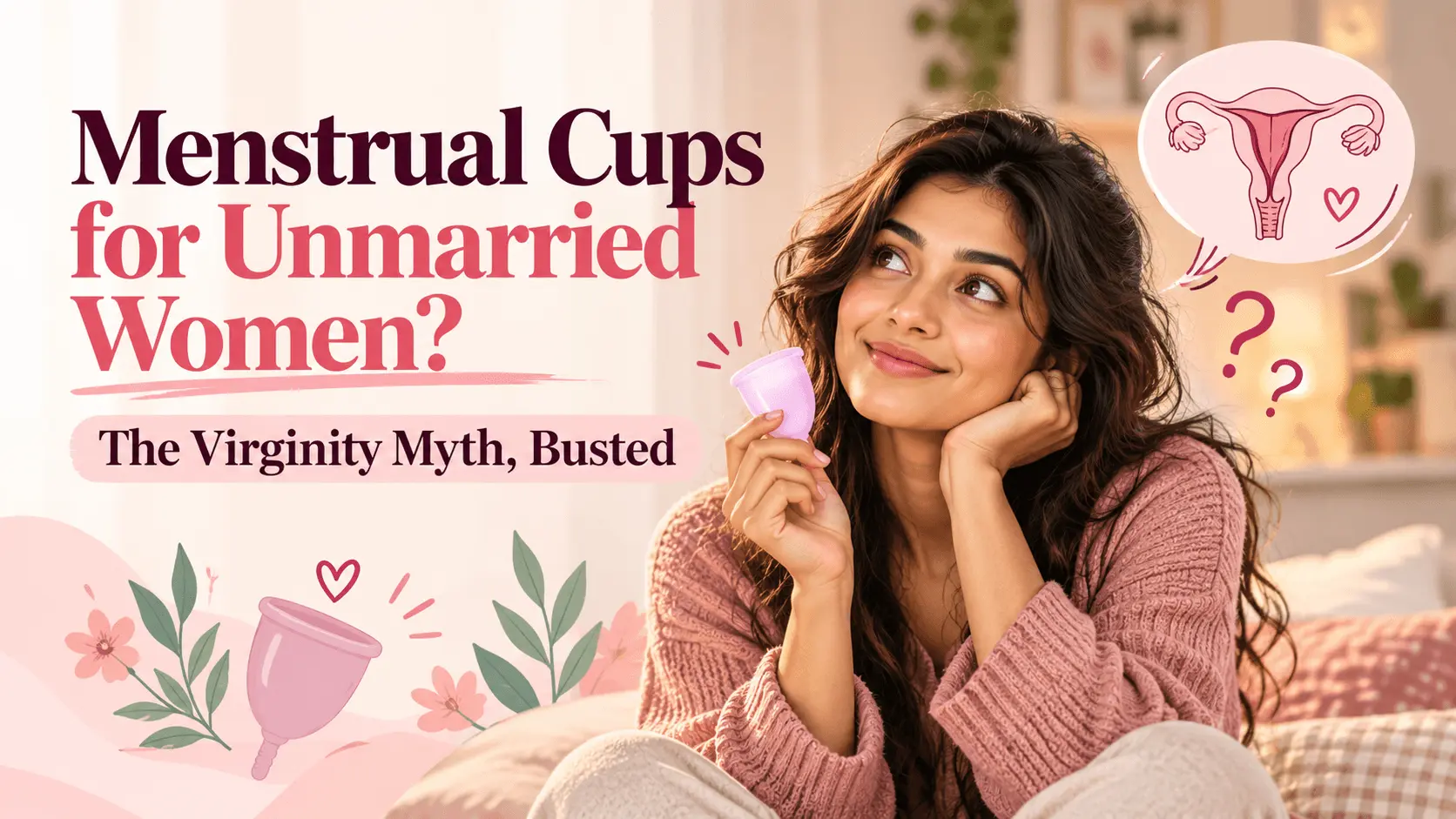
Can Unmarried Women Use Menstrual Cups? Virginity Myth Busted
Worried a menstrual cup will affect your virginity? Learn the real hymen anatomy, why this myth persists in India, and how to safely use a cup for the first time.
Yes, unmarried and sexually inactive women can safely use menstrual cups. The hymen is not a "seal" that blocks the vaginal opening — it's a thin, elastic ring of tissue with a natural opening, and it does not determine or prove virginity. Medical experts confirm that using a menstrual cup does not cause a woman to "lose her virginity," since virginity is a social concept, not a physical state. Despite this, only about 1% of Indian women currently use menstrual cups, largely because of this myth — this guide explains the real anatomy, how to use a cup safely for the first time, and how to think past a belief that still holds so many women back.
Somewhere in a pharmacy, or scrolling through an online store at midnight, a lot of young Indian women have had the exact same thought: I want to try a menstrual cup, but what if it... changes something? And then, because nobody ever properly explained what that "something" even is, the cup goes back in the cart, unbought, for another year.
If this is you, please know you're not being paranoid or dramatic. You grew up in a culture that has spent generations tying a woman's worth to an invisible, mostly mythical body part. That's not a small thing to unlearn alone, at 1 a.m., based on a worried WhatsApp forward from a well-meaning relative. So let's unlearn it together, properly, with the actual anatomy and the actual medical facts.
Key Takeaways
- The hymen is not a seal or barrier — it's a thin, elastic ring of tissue at the vaginal opening that already has a natural opening in it, even before any sexual activity.
- Using a menstrual cup does not make a woman "lose her virginity." Virginity is a social and cultural concept, not a measurable physical state, according to reproductive health experts.
- An estimated 8 in 10 people in India avoid menstrual cups specifically because they fear it will affect their hymen — a belief not supported by medical science.
- Only about 1% of Indian women currently use menstrual cups, largely due to this myth, lack of awareness, and social taboo.
- A smaller-sized cup, gentle insertion, and a little patience make menstrual cups genuinely usable for unmarried, sexually inactive, and teenage users alike.
- You are allowed to make this choice based on facts and your own comfort — not on a myth nobody has ever been able to medically prove.
Let's Start With What a Hymen Actually Is
This is the part almost nobody explains properly, and it changes everything once you actually understand it.
The hymen is a thin, elastic rim of tissue located just inside the vaginal opening. It is not a solid membrane covering the entire entrance the way a plastic seal covers a food container. According to research presented by Norwegian doctors Nina Brochmann and Ellen Støkken Dahl in their widely cited TEDx talk on this exact myth, the hymen is more accurately described as ring-shaped or crescent-shaped, already featuring a natural opening in its centre — the same opening that allows menstrual blood to pass through every single month, virgin or not.
Think of it less like a seal, and more like a hair scrunchie. It has some give, some stretch, and an opening already built into its shape. It isn't something that "breaks" cleanly on a single occasion and then is gone forever.
The Two Myths Hiding Inside One Bigger Myth
The belief that menstrual cups threaten virginity actually rests on two separate, smaller myths, and once each one falls apart, the whole fear does too.
Myth 1: All virgins bleed the first time something enters the vagina.
This isn't true. Because the hymen is elastic, many women's hymens stretch rather than tear during first-time penetration, intercourse included, and simply never bleed at all. A lack of bleeding has never reliably proven anything about a person's sexual history.
Myth 2: The hymen "disappears" or is permanently altered the first time anything is inserted.
Also not true. The hymen can be present in different shapes and thicknesses for different women, and it can change gradually over time — through sport, exercise, tampon or cup use, or sexual activity — without any single, clean, detectable "before and after" moment that medicine can reliably point to.
Put these two myths together, and you get the real, evidence-based conclusion: the state of a woman's hymen simply cannot be used to prove or disprove virginity, which is exactly why gynaecologists and human rights organisations alike have pushed back so firmly against so-called "virginity tests."
Why This Myth Has Survived So Long, Especially in India
This isn't just an isolated old wives' tale — it's deeply tied to how virginity has historically been policed in Indian society. Reporting from The Swaddle notes that India's cultural obsession with virginity has shaped real, ongoing practices — from communities historically relying on "white bedsheet" tests to determine a bride's purity, to the continued, widely condemned use of invasive physical exams on survivors of sexual assault. In this context, it's not surprising that something as simple as menstrual hygiene has gotten tangled up in questions of morality that were never medically relevant to begin with.
Globally, human rights organisations have been unambiguous about this. Human Rights Watch has publicly declared so-called virginity tests "unscientific, inhuman, and degrading," and Amnesty International has described forced virginity testing as a form of torture in certain documented contexts. A systematic review of 17 separate studies, cited in reproductive health research on this topic, found that physical examination is not a reliable way to determine whether someone has had intercourse — reinforcing, from a completely different angle, exactly what the hymen's actual anatomy already tells us.
And here's something worth being honest about: even some doctors still unknowingly repeat this myth. One Mumbai-based gynaecologist, quoted in a report by Down To Earth, advised against menstrual cups for unmarried, sexually inactive women specifically because of concern about the hymen — a view that reputable reproductive health researchers would now consider outdated. This isn't meant to shame that doctor; it's meant to show just how deeply this belief has settled into everyday medical conversation, even among well-trained professionals, which makes it even more important to seek out current, evidence-based information for yourself.
So, Can You Actually Use a Menstrual Cup If You're a Virgin?
Yes. According to reproductive health resources including The Period Co., virgins can use menstrual cups just like anyone else. Inserting a menstrual cup is not a sexual act, and even if it does gently stretch or reshape the hymen, that does not mean a person is "no longer a virgin" — because, again, virginity was never something the hymen could reliably measure in the first place.
That said, it's genuinely fair to feel some first-time nervousness or discomfort, the same way anyone might feel trying any new product for the first time. That's a completely normal physical and emotional adjustment — not a sign you're doing something wrong, or something your body "isn't ready for."
Pads vs. Tampons vs. Menstrual Cups: An Honest Comparison
If you're trying to decide whether a cup is right for you at all, here's how the three most common options actually compare.
| Factor | Sanitary Pads | Tampons | Menstrual Cups |
|---|---|---|---|
| Insertion required | No | Yes | Yes |
| Wear time | 4–6 hours | Up to 8 hours | Up to 8–12 hours |
| Reusable | No | No | Yes, for up to a year or more |
| Environmental impact | High (landfill waste) | High (landfill waste) | Low |
| Cost over time | Ongoing monthly expense | Ongoing monthly expense | One-time cost, then minimal |
| Affects virginity/hymen | No | No | No |
| Learning curve | Low | Low-Medium | Medium, improves quickly with practice |
Worth knowing: roughly 113,000 tonnes of menstrual waste accumulates in Indian landfills every year, largely from single-use pads and tampons. Beyond busting a myth, a genuine, practical reason many women eventually switch to cups is simply this — less waste, less recurring cost, and considerably less to think about once you're comfortable using one.
How to Use a Menstrual Cup for the First Time
If you've decided to try one, here's a clear, judgment-free walkthrough.
Step 1: Choose the Right Size
Most brands offer at least two sizes. According to guidance from Kauvery Hospital, teenagers and women who haven't given birth vaginally should generally start with the smallest size available. If you're unsure, it's completely reasonable to ask a gynaecologist for a recommendation, the same way you might ask about any new health product.
Step 2: Sterilise Before First Use
Boil the cup in water for about 5 to 10 minutes before using it for the first time, and before every new cycle after that.
Step 3: Get Comfortable and Use Lubrication if Needed
Wash your hands thoroughly. If you're a first-time user, a little water-based lubricant around the rim can make insertion noticeably smoother and more comfortable.
Step 4: Fold and Insert
Fold the cup using a simple technique — the "punch-down" fold (pressing one side of the rim down into the cup to create a small point) is often recommended as the easiest for beginners. Gently insert it, angling slightly toward your lower back rather than straight up, similar to the angle used for a tampon.
Step 5: Let It Open and Check the Seal
Once inside, the cup should pop open and create a gentle seal. When placed correctly, most women report they genuinely don't feel it at all. If you're uncertain whether it has opened properly, you can gently run a finger around the base to check.
Step 6: Wear It, Then Remove It Mindfully
A cup can typically be worn for up to 8 to 12 hours before needing to be emptied. To remove it, wash your hands again, gently pinch the base to release the seal, and ease it out, using your pelvic floor muscles (the same ones you'd use to stop urinating midstream) to help guide it down.
Step 7: Clean and Reuse
Empty the contents into the toilet, rinse the cup with water (avoid using soap directly, as some can irritate sensitive skin), and reinsert. At the end of your cycle, sterilise it again in boiling water before storing it for next month.
Is It Actually Safe? A Few Honest Notes
Menstrual cups are generally considered very safe, but a few genuine, practical points are worth knowing rather than glossing over.
- It may take more than one cycle to feel fully confident. Most first-time users describe an adjustment period, and that's normal — it doesn't mean you're using it wrong.
- If you have an IUD, exercise extra caution when removing the cup, since improper technique has, in rare cases, been linked to IUD displacement. It's worth discussing this specifically with your gynaecologist if you have one fitted.
- If you've recently given birth vaginally or had vaginal surgery, most guidance recommends waiting at least six weeks, and getting your doctor's clearance, before resuming cup use.
- Discomfort beyond the initial adjustment period isn't something to push through. If a cup consistently feels painful rather than just unfamiliar, it may be the wrong size, or it may simply not be the right fit for your body — and that's okay too.
Other Menstrual Cup Myths Worth Clearing Up While We're At It
Since we're already busting one deeply rooted myth, a few related ones tend to travel in the same pack, so let's clear those up too.
Myth: Menstrual cups can get "lost" inside your body.
This isn't physically possible. The vaginal canal is a closed space that ends at the cervix, which has an opening far too small for a cup to pass through. A cup can shift position or feel harder to reach, but it cannot travel further into your body or disappear.
Myth: Using a cup is unhygienic compared to pads.
Research comparing menstrual products across the UK, India, Spain, China, and Canada found that when used and cleaned correctly, menstrual cups are not associated with higher infection risk than pads or tampons, and in some comparisons, users reported them as the better-performing option overall. Hygiene depends far more on correct use and regular cleaning than on which product you choose.
Myth: You can't exercise, swim, or be active while using a cup.
Actually, the opposite tends to be true for many women. Because a well-fitted cup creates a gentle internal seal rather than sitting externally, many users find cups considerably more reliable than pads during exercise, swimming, or long travel days — one of the genuinely practical reasons beyond the virginity myth that cups have grown in popularity.
Myth: You can feel a menstrual cup the entire time you're wearing it.
When inserted correctly and sized appropriately, most users report not feeling the cup at all once it's properly in place. Ongoing discomfort usually signals a sizing or positioning issue, not a problem with cups as a category.
The Numbers Tell Their Own Story
It's worth sitting with just how large this awareness gap actually is in India. A global survey on menstrual cup use referenced in public health research found that in parts of south India, even though a majority of women had heard of menstrual cups, actual usage and correct knowledge remained strikingly low — a clear sign that awareness alone hasn't been enough to shift behaviour, precisely because myths like this one keep outweighing the facts. Campaigns like "This Belief Is Unhygienic," run across India and the UAE, have specifically targeted the hymen myth as a public health message, not just a personal choice issue — a sign that medical and advocacy communities increasingly recognise this isn't a minor, private misunderstanding, but a genuine barrier to better menstrual health at a population level.
What to Say When Someone Questions Your Choice
Realistically, this myth doesn't just live in your own head — it often shows up from relatives, friends, or even partners who've absorbed the same misinformation you're now unlearning. You don't owe anyone a defensive explanation, but if you want one, here's a simple, calm way to put it: "The hymen doesn't actually work the way people think it does — it's not a seal, and doctors and researchers agree it can't prove virginity either way. This is just about my own health and comfort." You're allowed to say this plainly, without apology, and you're equally allowed to simply change the subject if you'd rather not explain yourself at all.
This Is Really About More Than a Period Product
If there's one thing worth sitting with here, it's this: the fear around menstrual cups was never really about the cup. It was about generations of being taught that a woman's worth, her reputation, even her family's honour, could hinge on an anatomical feature most people were never taught to understand correctly in the first place. Letting go of that fear isn't just about choosing a more comfortable, more sustainable period product — it's a small, private act of reclaiming a decision about your own body that was always supposed to be yours alone.
You get to decide what feels right for you, based on facts, not on a myth that medicine has already quietly moved past.
Frequently Asked Questions
The hymen is elastic, not a seal, so it may stretch rather than tear with cup use. Even if its shape changes slightly, this does not mean it is "broken" in any medically meaningful way, and it does not affect virginity.
Yes. Most brands make a smaller size specifically designed for teenagers and first-time users, and medical guidance confirms teenagers can use menstrual cups safely with proper technique.
No. There is no physical change from cup use that would be detectable or that indicates anything about your sexual history, since hymen appearance varies enormously between individuals regardless of any activity.
It can feel unfamiliar or slightly uncomfortable the first few times, similar to how a tampon might feel unfamiliar initially. Using a smaller size, going slowly, and using a little water-based lubricant can make this considerably easier.
It depends on personal preference. Cups are reusable, more environmentally friendly, and often more cost-effective over time, but pads or tampons may feel more familiar or convenient for some women. There's no single "correct" choice — only what works for your body and comfort.
This is a deeply personal health decision. You're not obligated to justify it to anyone, though understanding the real anatomy yourself can help you feel confident if you do choose to explain your reasoning.
No. Medical and human rights organisations, including Human Rights Watch, have stated clearly that no physical examination can reliably prove or disprove virginity, since there is no consistent, detectable physical marker for it.
Keep Reading
Two more reads from the Journal, thoughtfully chosen to continue from here.
 Periods
5 October 2026
White Discharge: What's Normal, What's Not & When to See a Doctor
Confused about white discharge? Learn what's normal, what colors and symptoms signal infection, and why this topic carries extra weight for Indian women.
Read more Periods
2 October 2026
Endometriosis: Why "Bad Periods" Might Be More Than Bad Periods
Severe period pain might be endometriosis, not "just bad periods." Learn the real symptoms, why diagnosis takes years in India, and what treatment actually looks like.
Read more