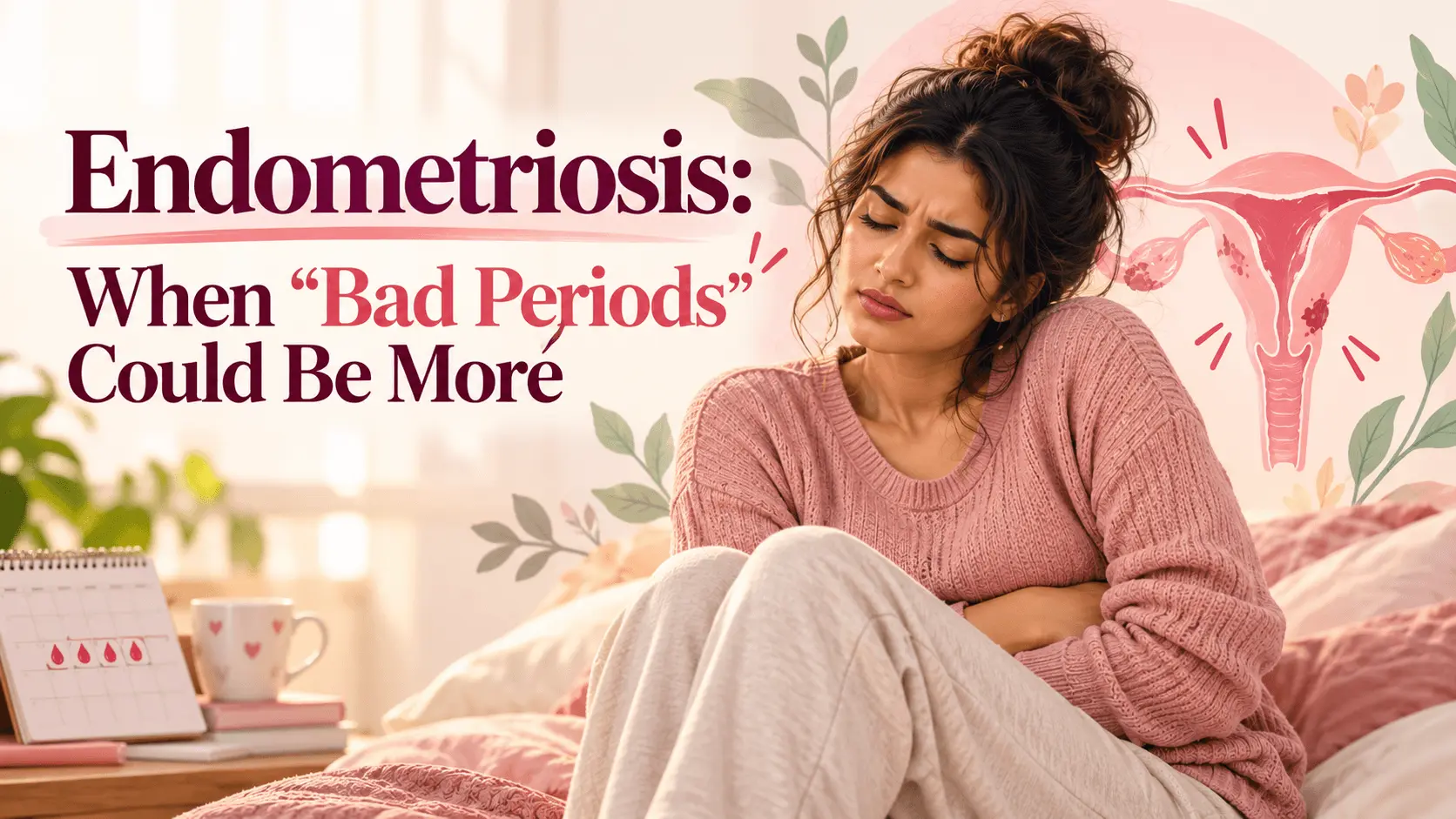
Endometriosis: Why "Bad Periods" Might Be More Than Bad Periods
Severe period pain might be endometriosis, not "just bad periods." Learn the real symptoms, why diagnosis takes years in India, and what treatment actually looks like.
Endometriosis is a chronic condition where tissue similar to the uterine lining grows outside the uterus, causing severe period pain, pain during sex, digestive issues, and sometimes infertility. It affects an estimated 42 million women in India alone, yet diagnosis is typically delayed by 7 to 10 years because symptoms are routinely dismissed as "normal" period pain. There is no cure, but the condition is manageable through pain medication, hormonal therapy, or surgery (laparoscopy), and the single most important step is simply believing a woman when she says her pain isn't normal.
Every family seems to have one. The aunt who missed work every month and never said why. The cousin who always "had a weak stomach" around her period. Maybe it's you — doubled over on a bathroom floor once a month since you were fourteen, popping painkillers that stopped working years ago, being told by everyone from your mother to your gynaecologist that this is simply what periods feel like for some women.
What if it isn't?
For an estimated 42 million women in India, what gets written off as "just bad periods" is actually endometriosis — a real, diagnosable, treatable medical condition that takes, on average, 7 to 10 years to even get a name. That's not a typo. A decade of pain, often beginning in the teenage years, before a woman finally hears the word that explains what's been happening to her body all along.
Key Takeaways
- Endometriosis happens when tissue similar to the uterine lining grows outside the uterus — on the ovaries, fallopian tubes, or pelvic lining — and bleeds and causes inflammation every month, just like a normal period, but with nowhere for that blood to go.
- India is home to roughly 42 million women with endometriosis — about 25% of the global burden — yet diagnosis is delayed by 7 to 10 years on average, largely due to stigma around menstruation and the normalisation of period pain.
- The classic warning signs are severe period pain, pain during sex, chronic pelvic pain, and pain during bowel movements or urination — but symptom severity doesn't always match disease severity.
- A definitive diagnosis currently requires laparoscopy (minor surgery), though doctors can often start treatment based on symptoms and ultrasound findings without waiting for surgical confirmation.
- There is no cure, but endometriosis is manageable through pain relief, hormonal treatment, or surgery, and early diagnosis genuinely improves long-term outcomes, including fertility.
- You deserve to be taken seriously the first time you describe this pain, not the fifth or the fifteenth.
What Endometriosis Actually Is
To understand endometriosis, picture how a normal period works. Every month, the lining of your uterus, called the endometrium, thickens in preparation for a possible pregnancy. If pregnancy doesn't happen, that lining breaks down and leaves your body as your period.
Now imagine that same type of tissue growing somewhere it doesn't belong — on your ovaries, your fallopian tubes, the lining of your pelvis, or even your bladder or bowel. According to Mayo Clinic, this misplaced tissue still behaves exactly like it would inside the uterus: it thickens, breaks down, and bleeds with every cycle. The problem is, this blood has nowhere to exit the body. Over time, it causes irritation, inflammation, and can lead to scar tissue and adhesions — sticky fibres that bind organs together that were never meant to touch.
This is why endometriosis hurts so much more than an ordinary period. It isn't just your uterus contracting. It's inflammation and scarring happening in places never designed to handle it, month after month, often for years before anyone intervenes.
The Classic Symptoms — and the Ones Nobody Mentions
Doctors often describe three core symptoms, sometimes called the "classic triad": severe pain during periods (dysmenorrhea), pain during sex (dyspareunia), and difficulty getting pregnant (infertility). But endometriosis rarely announces itself that neatly, and plenty of women experience symptoms far beyond this short list.
| Symptom Category | What It Can Look Like |
|---|---|
| Period pain | Pain severe enough to affect daily life, sometimes starting before bleeding begins and continuing after it ends |
| Pelvic pain | Chronic, dull or sharp pain in the lower abdomen, not limited to your period |
| Pain during sex | Often described as deep pain, particularly during penetration |
| Bowel and bladder symptoms | Pain during bowel movements or urination, especially around your period; bloating, diarrhoea, or constipation |
| Heavy or irregular bleeding | Periods that are heavier or longer than what feels normal for you |
| Fatigue | A deep tiredness that doesn't match how much rest you're getting |
| Fertility difficulty | For some women, endometriosis is only discovered while investigating why they haven't conceived |
| Emotional toll | Depression, anxiety, and a persistent feeling of isolation are well-documented alongside the physical symptoms |
Here's a detail that genuinely surprises most people, including some doctors early in their careers: the severity of your symptoms doesn't reliably predict how advanced your endometriosis is. According to research published in the Journal of Clinical Medicine, some women with stage four, the most advanced form, report barely any symptoms, while others with minimal, stage one disease experience severe, life-disrupting pain. This mismatch is part of why the condition is so often missed or dismissed — there's no simple, predictable pattern for doctors, or patients, to rely on.
Why the Diagnosis Takes So Long in India Specifically
This is the part that deserves real anger, not just sympathy. According to the ICMR-National Institute for Research in Reproductive and Child Health (ICMR-NIRRCH), India carries one of the largest burdens of endometriosis in the world, and The George Institute for Global Health estimates the country represents roughly 25% of the global disease burden. Despite this scale, diagnosis is routinely delayed by 7 to 10 years from the first symptom.
Globally, the picture isn't dramatically better — research published in the Journal of Clinical Medicine notes a worldwide average delay of 8 to 12 years. But in India, this delay is compounded by something specific: menstruation and infertility are two of the most stigmatised topics in the country, according to coverage in The Daily Star examining the condition across the subcontinent. A young woman reporting severe period pain is frequently told it's normal, that it will ease after marriage, or after childbirth — reassurances offered with love, but with no medical basis behind them.
One woman's account, reported by The Quint, captures this starkly: it took her 15 years of unbearable pain to finally receive a diagnosis. She described the experience of being repeatedly disbelieved by doctors as feeling "medically gaslit" — a term that resonates with countless women who've had real, physical pain explained away as exaggeration, low pain tolerance, or simply "part of being a woman."
Why This Delay Actually Matters
This isn't just about years of unnecessary suffering, though that alone would be reason enough to care. A delayed diagnosis also means a delayed chance to protect fertility. Research referenced in a study on early-stage endometriosis diagnosis notes a roughly linear decline in fertility potential as the disease progresses through its stages — which means the years lost to "it's probably just bad periods" aren't only years of pain. For some women, they're years that affect whether, and how easily, they're later able to conceive.
How Endometriosis Is Actually Diagnosed
If you recognise yourself in the symptoms above, here's what the diagnostic path typically looks like.
Step 1: A Detailed Conversation and Pelvic Exam
Your doctor will ask about your pain — when it happens, how severe it is, what makes it better or worse — alongside your family history, since endometriosis can run in families. A physical pelvic exam may follow, though it's worth knowing upfront that a normal exam doesn't rule the condition out.
Step 2: Imaging
A transvaginal ultrasound or MRI can sometimes detect larger endometriosis growths, called endometriomas, particularly on the ovaries. However, according to the Merck Manual, imaging tests may not reliably detect smaller or more diffuse patches of the disease, which is an important limitation to understand — a clear scan doesn't necessarily mean a clear diagnosis.
Step 3: Laparoscopy — The Only Definitive Test
Currently, the only way to confirm endometriosis with certainty is a minor surgical procedure called laparoscopy, where a surgeon inserts a thin, lit camera through a small incision to directly view, and often biopsy or treat, the tissue. Mayo Clinic notes that with proper planning, many surgeons can both diagnose and treat the condition in the same procedure, which can spare a patient a second surgery altogether.
This surgical requirement is genuinely one of the biggest barriers to timely diagnosis — it's invasive, it requires a skilled specialist, and in many parts of India, access to surgeons experienced specifically in endometriosis excision remains limited, as noted by the Endometriosis Foundation of India. The encouraging development: researchers are actively working on non-invasive biomarker tests, using blood or other samples, that could one day make early diagnosis possible without surgery at all. This research isn't ready for widespread clinical use yet, but it represents real, active progress.
The Four Stages of Endometriosis
Doctors classify endometriosis into four stages based on the location, number, size, and depth of the growths found during laparoscopy — not based on how much pain a person reports.
| Stage | What It Generally Means |
|---|---|
| Stage I (Minimal) | A few small, shallow growths or spots of inflammation |
| Stage II (Mild) | More growths, slightly deeper than Stage I |
| Stage III (Moderate) | Many growths, some deep, possibly with small cysts on one or both ovaries |
| Stage IV (Severe) | Many deep growths, larger ovarian cysts, and significant adhesions binding organs together |
Remember: a woman with Stage IV disease can have minimal symptoms, and a woman with Stage I can be in severe, disabling pain. The stage describes what a surgeon sees, not what a patient feels.
Treatment: Managing, Not Curing
There is currently no cure for endometriosis, and it's important to say that honestly rather than overpromise. What exists instead is a genuinely effective range of options to manage symptoms, slow progression, and protect fertility where that matters to you.
First-Line Treatment: Pain Relief and Hormones
Most doctors start with NSAIDs (like ibuprofen) for pain, alongside hormonal treatments such as combined birth control pills, which can reduce or eliminate periods altogether and, with them, much of the monthly inflammation driving the pain.
Second-Line Treatment: Stronger Hormonal Therapy
If first-line treatment isn't enough, doctors may move to more targeted hormonal medications, such as GnRH analogues, which create a temporary, low-estrogen state that suppresses the growth of endometriosis tissue.
Surgical Treatment
For women whose symptoms don't respond to medication, or whose fertility is affected, laparoscopic surgery to remove or destroy the endometriosis tissue is often recommended. Mayo Clinic notes that even in severe cases, most endometriosis can still be treated laparoscopically, meaning through small incisions rather than major open surgery. Surgical removal while preserving the uterus and ovaries can also meaningfully improve the chances of conceiving for women trying to get pregnant.
It's worth knowing, honestly, that surgical relief isn't always permanent — symptoms can return over time without ongoing hormonal management afterward, which is why most treatment plans combine surgery with a longer-term medical strategy rather than treating surgery as a one-time fix.
What Causes Endometriosis? The Honest Answer Is: We Don't Fully Know
This is genuinely one of the more frustrating parts of this condition, even for doctors. Despite decades of research, there's no single confirmed cause of endometriosis. Several theories exist, and more than one may be true at once for different women.
- Retrograde menstruation — the most widely discussed theory, where some menstrual blood flows backward through the fallopian tubes into the pelvis instead of leaving the body, carrying endometrial cells that then implant and grow outside the uterus.
- Genetics — endometriosis tends to run in families, and having a close relative with the condition raises your own likelihood of developing it.
- Immune system factors — some researchers believe immune dysfunction may prevent the body from clearing misplaced endometrial cells the way it normally would.
- Hormonal influence — estrogen is known to fuel the growth of endometriosis tissue, which is part of why hormonal treatments are a core part of managing the condition.
- Emerging research on the microbiome — some newer studies, including ongoing clinical research, are exploring whether bacteria in the gut and pelvic cavity play a role in triggering the inflammation associated with endometriosis, though this research is still in its early stages.
None of these theories fully explain why some women develop endometriosis and others don't, even with similar risk factors. What's genuinely worth knowing is this: nothing you did caused this. It isn't linked to anything you ate, how you live, or any period-related habit you were ever criticised for.
Living With Endometriosis Day to Day
Beyond diagnosis and treatment, there's the quieter, ongoing work of actually living alongside a chronic condition. A few things women with endometriosis often find genuinely useful, alongside medical treatment, not instead of it.
- Heat therapy during flare-ups can ease pelvic pain the same way it helps with ordinary period cramps, by relaxing tense muscles and improving blood flow.
- Gentle movement, like walking or restorative yoga, on lower-pain days can help manage overall inflammation and mood, even though intense exercise during a flare may feel impossible.
- Building a support system who understands this isn't "just a bad period" matters more than it might seem — whether that's a partner, a friend, or an online community of women navigating the same condition, since the isolation around this illness is as real as the physical pain.
- Planning around your cycle where you can — scheduling demanding work commitments or travel away from your most symptomatic days, when your job and life allow for it, can meaningfully reduce the sense that this condition controls every part of your calendar.
- Revisiting your treatment plan periodically. What works at 22 may need adjusting at 32, especially around major life changes like trying to conceive or approaching perimenopause.
What You Can Do While You're Figuring This Out
If you suspect you might have endometriosis, or you're waiting for an appointment, here's what genuinely helps in the meantime:
- Track everything. Keep a detailed record of your pain, its timing, severity, and any other symptoms across at least two to three cycles. This single piece of evidence is one of the most useful things you can hand a doctor.
- Ask for a referral to a gynaecologist with specific endometriosis experience, not just a general practitioner, if your symptoms are significant. The Endometriosis Foundation of India and similar advocacy groups can often point you toward specialists.
- Don't settle for the first dismissal. If a doctor tells you your pain is normal without really examining your history, it's entirely reasonable to seek a second opinion.
- Consider a self-assessment tool as a starting point, such as the one developed through the Bayer For Her initiative in India, to help you organise your symptoms before an appointment — not as a diagnosis, but as a conversation-starter.
The Part That Isn't Physical
Living with undiagnosed, dismissed pain for years takes a toll that doesn't show up on any scan. Research consistently links endometriosis with higher rates of depression, anxiety, and a persistent sense of isolation — not as a side effect of the disease process alone, but compounded by the exhausting experience of not being believed, appointment after appointment.
If you've spent years being told to just take a painkiller and get on with your day, please hear this clearly: that exhaustion, that frustration, that creeping self-doubt about whether you're somehow overreacting — none of it means you're imagining this. It means you've been carrying something real without the validation you deserved from the very beginning.
You Are Allowed to Push for Answers
If there's one thing worth taking from this, it's permission — permission to stop apologising for your pain, and permission to keep asking until someone actually listens. A period that disrupts your life every single month, year after year, is not something you are required to simply manage quietly. Getting a name for what you're experiencing doesn't just bring relief; it brings back a kind of control that years of dismissal can quietly take away.
You know your body. Trust that, even when it takes a few tries to find someone else who will too.
Frequently Asked Questions
Ordinary period cramps usually ease with over-the-counter painkillers and don't significantly disrupt your daily life. Pain that's severe enough to miss school, work, or plans every month, or that doesn't respond to usual pain relief, is worth discussing with a doctor as a possible sign of endometriosis.
Not definitively, at least not yet. Ultrasound and MRI can sometimes detect larger growths, but laparoscopy remains the only way to confirm the diagnosis with certainty, though researchers are actively developing non-invasive tests for the future.
No. Many women with endometriosis conceive naturally, sometimes without any fertility treatment at all. The risk of fertility difficulty tends to rise with disease severity, which is part of why earlier diagnosis and treatment matter.
No, though the two are often confused because some symptoms overlap, like irregular periods and pelvic discomfort. PCOS involves a hormonal imbalance affecting ovulation, while endometriosis involves tissue growth outside the uterus. It's possible, though less common, to have both conditions at once.
No current evidence supports diet alone as a cure, though some women find that anti-inflammatory eating patterns help manage symptoms alongside medical treatment. It's best discussed with your doctor as a complement to, not a replacement for, medical care.
It can begin as early as the teenage years, soon after a girl starts menstruating. This is part of why dismissing a teenager's severe period pain as something she'll "grow out of" can be particularly risky — it may delay diagnosis by years.
The global prevalence is broadly similar across countries, but India's sheer population size means the absolute number of affected women — an estimated 42 million — is enormous, and the diagnostic delay here tends to be compounded by stigma around discussing menstrual and reproductive health openly.
Keep Reading
Two more reads from the Journal, thoughtfully chosen to continue from here.
 Periods
5 October 2026
White Discharge: What's Normal, What's Not & When to See a Doctor
Confused about white discharge? Learn what's normal, what colors and symptoms signal infection, and why this topic carries extra weight for Indian women.
Read more Periods
4 October 2026
Can Unmarried Women Use Menstrual Cups? Virginity Myth Busted
Worried a menstrual cup will affect your virginity? Learn the real hymen anatomy, why this myth persists in India, and how to safely use a cup for the first time.
Read more