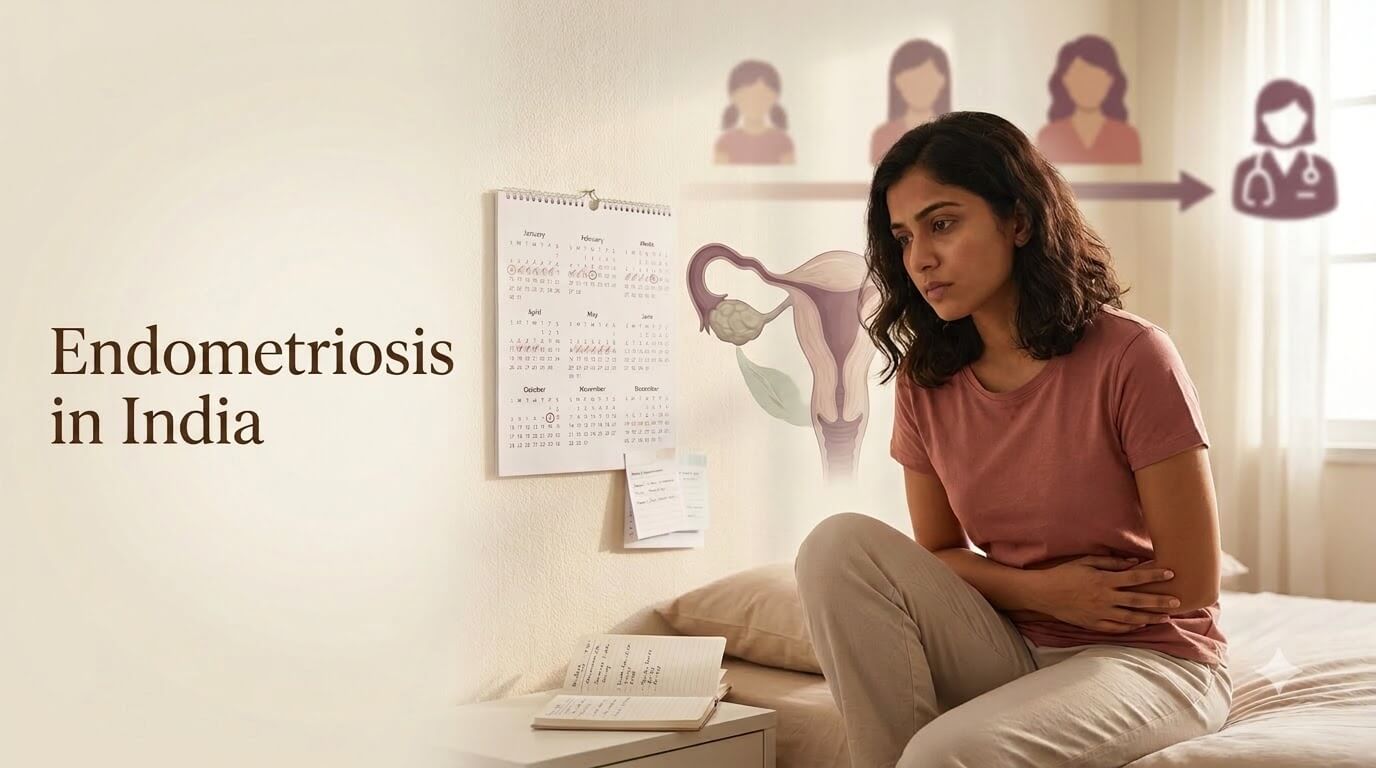
Endometriosis in India: Why Diagnosis Takes 6+ Years
Indian women wait an average of 6.3 years for an endometriosis diagnosis. Here's why — and what to say to get taken seriously sooner.
She's had period pain since she was a teenager. Bad enough to miss school some months, bad enough that she learned to just push through it, because every adult in her life told her the same thing: periods hurt, that's just how it is. She's now in her mid-20s, still in pain every single cycle, and still waiting for someone to tell her why.
This isn't a rare story. It's the average story. A study published in the Indian Journal of Medical Research, based on in-depth interviews with women across two Indian states, found that the average time between when endometriosis symptoms start and when a woman actually gets diagnosed is 6.3 years — and for some women in the study, that wait stretched as long as 21 years.
What Endometriosis Actually Is
Endometriosis happens when tissue similar to the uterine lining grows outside the uterus, most often on the ovaries or pelvic lining, where it causes inflammation and pain that gets worse with each cycle. It's not rare — researchers estimate it affects roughly 10% of women of reproductive age in India, which is a similar rate to what's reported globally. NavPoorna's guide, Know Your Cycle, covers this condition in more depth alongside the other causes of period pain it commonly gets mistaken for.
The Real Number: 6.3 Years
Six years is a long time to live with pain before getting an answer, and it's worth sitting with what that actually looks like: years of missed school or work, repeated doctor visits that led nowhere, and, for many women, a slow acceptance that this is just what their body is like. The same study found the diagnostic delay ranged from 0 months to a full 21 years, which means for some women, this isn't a story about a slow system — it's a story about two full decades of unanswered pain.
Six years is not a diagnosis running late. It's six years of a body being told its pain doesn't count.
Why the Wait Is So Long
The Indian Journal of Medical Research study identified a consistent set of reasons behind the delay, and none of them are about women failing to notice something was wrong.
Pain Gets Normalized by Everyone Around Her
Every woman in the study reported that her pain had been dismissed as ordinary period pain — by family, by friends, and often by the very doctors she went to for help. One detail from the research is hard to forget: some women were told by healthcare providers that their pain would likely subside after marriage, as though a wedding were a medical intervention. It isn't, and for many women in the study, the pain didn't go anywhere.
It Gets Misdiagnosed as Something Else
Endometriosis symptoms overlap heavily with several other conditions, and the study found women were frequently misdiagnosed with pelvic inflammatory disease, adenomyosis, fibroids, or PCOS/PMOS before anyone considered endometriosis specifically. Each misdiagnosis adds months or years of treatment for the wrong condition before the real one gets addressed.
There's No Simple Test
Unlike a thyroid problem, which shows up on a basic blood test, endometriosis currently has no reliable non-invasive test. The only definitive way to diagnose it is laparoscopy — a surgical procedure — which understandably makes both doctors and patients hesitant to pursue it quickly, especially when symptoms could plausibly be explained by something simpler first.
Healthcare Access Plays a Real Role
Around 70% of Indian women live in rural areas, where much of the population relies on public health infrastructure for first-line care. Specialized gynaecological evaluation for a condition like endometriosis often isn't available at that first point of contact, which adds another layer of delay before a woman even reaches someone equipped to investigate further.
This Isn't Only an Indian Problem — But It Isn't a Small One Here Either
It's worth knowing that long diagnostic delays for endometriosis are a global pattern, not something unique to India — studies report similar or even longer waits in the UK, the US, and elsewhere. What makes the Indian context specific is the layer of cultural framing on top of the medical challenge: period pain is often treated as something to privately endure rather than a symptom to investigate, which can add real time to a delay that's already difficult everywhere.
What This Means for You
If your period pain is severe enough to affect school, work, or daily life, and standard pain relief doesn't touch it, that's not something to keep normalizing for another year. Ask your gynaecologist directly whether endometriosis should be investigated, and don't let "it's probably normal" be the end of the conversation if the pain itself doesn't feel normal to you. You know your own body's pattern better than a rushed appointment can capture — and after reading this, you now also know that a 6-year wait isn't inevitable, it's a pattern worth interrupting as early as you can.
References
- Indian Journal of Medical Research — Experiences of Women with Endometriosis & Their Partners in India: Findings From a Qualitative Study
- PMC — Experiences of Women with Endometriosis & Their Partners in India
- The Lancet Western Pacific — Menstrual Reform: Cultural Roots of Delayed Endometriosis Diagnosis in the Asia-Pacific Region
This article is educational and doesn't replace advice from your own doctor. If period pain is affecting your daily life, please see a Gynaecologist.
Keep Reading
Two more reads from the Journal, thoughtfully chosen to continue from here.
 Periods
15 September 2026
Period Pain or Something More? How to Tell the Difference
Not all period pain is "just cramps." Learn the specific signs that separate normal menstrual pain from something worth a doctor's visit.
Read more Periods
8 September 2026
Period Blood Color Meaning: What's Normal, What's Not
Bright red, brown, or pink — what does your period blood color actually mean? Here's the real science, and when it's worth seeing a doctor.
Read more