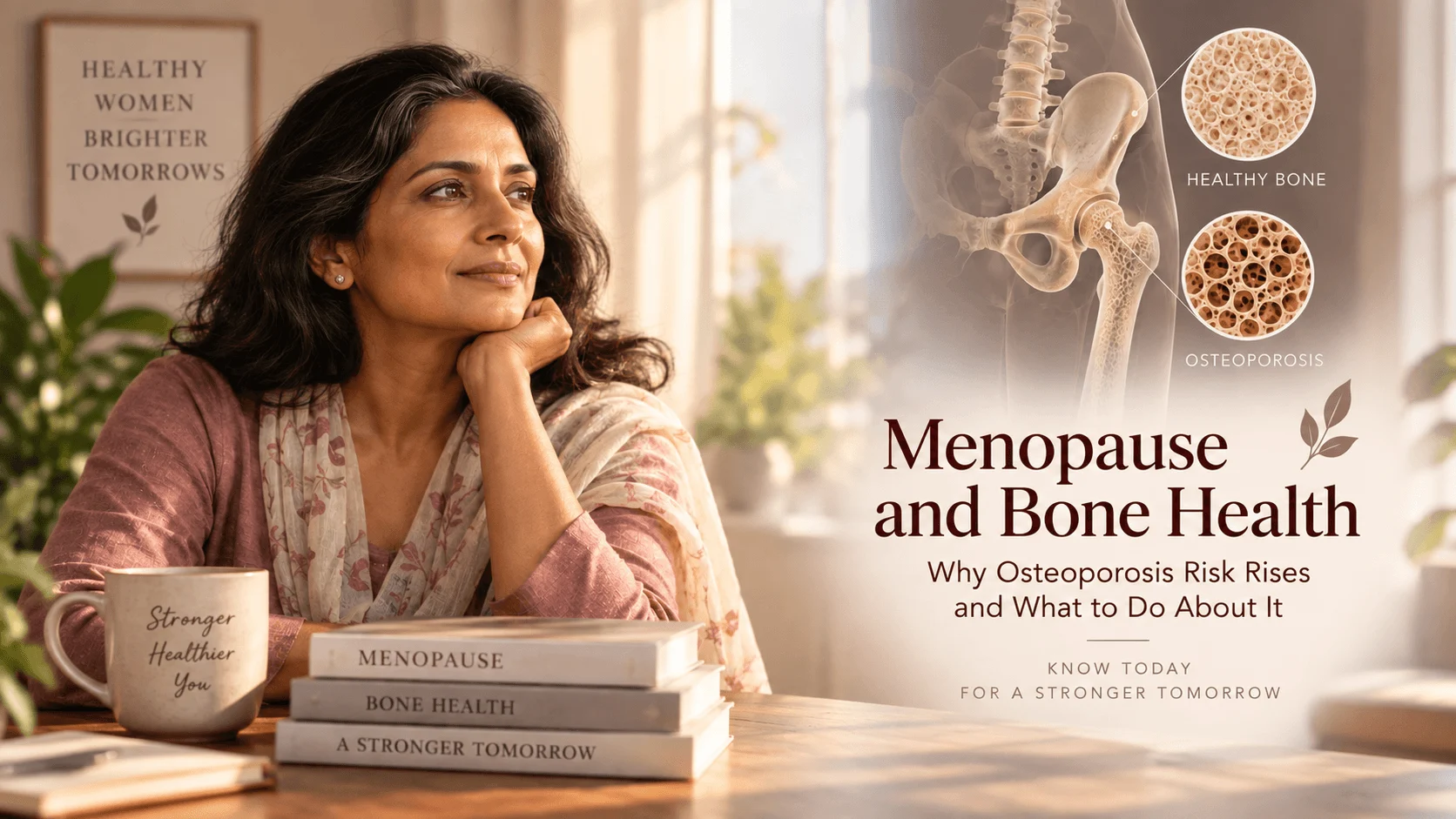
Menopause and Bone Health: Why Osteoporosis Risk Rises
Why does osteoporosis risk jump after menopause? The real science, Indian-specific risk factors, and what actually protects your bones.
Nobody warns you that menopause has a second act you can't see or feel happening. While hot flashes and mood swings get all the attention, something quieter is going on underneath: your bones are losing density, often without a single symptom, until a fracture from a fall that shouldn't have caused one reveals just how much has changed.
This isn't a rare, unlucky outcome. It's the expected biology of what happens when estrogen drops — and understanding why it happens is the first real step toward doing something about it.
Key Takeaways
- Estrogen directly regulates bone remodeling, and its decline at menopause tips the balance sharply toward bone loss.
- One in three women over 50 will experience an osteoporosis-related fracture in their lifetime, according to the International Osteoporosis Foundation.
- An Indian study found 82.2% of postmenopausal women had low bone mass — only 18% had normal bone density.
- Indian women face compounded risk: earlier menopause, lower peak bone mass, high parity and prolonged breastfeeding, and widespread vitamin D deficiency.
- Bone loss can actually begin during perimenopause, before periods have even stopped.
- The first five years after menopause is the window of fastest bone loss — and the most important time to act.
Why Menopause and Bone Health Are Connected
Bone isn't a fixed, static structure — it's constantly being broken down and rebuilt in a process called remodeling. Cells called osteoclasts break down old bone, while cells called osteoblasts build new bone to replace it. In a healthy, balanced system, these two processes stay roughly even.
Estrogen is one of the main hormones keeping that balance in check. It restrains osteoclast activity and supports the signals that keep osteoblasts building. When estrogen drops sharply at menopause, that restraint disappears — osteoclasts become more active, bone breakdown accelerates, and bone formation can't keep pace. The result is a net loss of bone density, along with changes to the bone's internal structure that make it more fragile, not just thinner.
The Numbers That Should Get Your Attention
According to the International Osteoporosis Foundation, one in three women over the age of 50 will experience an osteoporosis-related fracture at some point in their life — a scale of risk that puts this on par with, or ahead of, several conditions that get far more everyday attention.
The Indian data is even more striking. A recent study measuring bone density in postmenopausal Indian women found that only 18% had normal bone density readings. The remaining 82.2% fell into either osteopenia (44.7%) — a lower-than-normal bone density that hasn't yet reached the osteoporosis threshold — or osteoporosis itself (37.5%). A separate literature review estimated that up to 62% of postmenopausal Indian women are affected by this condition in some form.
Why It's Called the "Silent Disease"
Osteoporosis rarely announces itself. There's no pain, no obvious symptom, and no early warning sign that most women would recognize on their own — bone density can decline for years without a single noticeable change in how you feel day to day. For many women, the first real sign is a fracture itself, often from a fall that wouldn't have caused any injury in someone with normal bone density: a stumble on stairs, a minor slip in the bathroom, even a hard sneeze in advanced cases. This is exactly why screening matters more than symptom-watching here — waiting to feel something wrong means, by definition, waiting too long.
Why Indian Women Face Extra Risk
This isn't only about estrogen decline — several factors specific to Indian women compound the risk further.
Earlier menopause, less time to prepare. As covered in NavPoorna's perimenopause guide, the average age of menopause in India is around 46.2 years, compared to a global average closer to 51. Reaching menopause earlier means the protective effect of estrogen ends sooner, extending the number of years spent in a lower-estrogen state.
Lower peak bone mass to begin with. Research indicates Indian women often reach a lower peak bone mass in their 20s and 30s than Western women do, before menopause-related loss even begins. Starting from a lower baseline means the same percentage of loss has a bigger practical impact.
High parity and prolonged breastfeeding. Repeated pregnancies and extended periods of breastfeeding both draw on the body's calcium reserves. Across multiple pregnancies and years of cumulative breastfeeding, this adds up to meaningful additional calcium depletion over a woman's reproductive life.
Widespread vitamin D deficiency. Despite abundant year-round sunlight, vitamin D deficiency remains extremely common across India, largely due to indoor lifestyles, clothing patterns, and limited direct sun exposure. Since vitamin D is essential for calcium absorption, this deficiency undermines bone health independently of estrogen levels.
Your bones don't wait for a diagnosis to start changing. The only real question is whether you find out early enough to do something about it.
It Can Start Before Menopause Itself
Here's a detail that surprises most people, including many who consider themselves well-informed about menopause: bone loss doesn't wait until your final period. Research from the PeKnO study — which specifically tracked bone density during perimenopause — found that bone loss accelerates during perimenopause itself, linked to declining ovulation frequency, even while overall estrogen levels are technically still within a normal range. In other words, the transition covered in NavPoorna's Is It Perimenopause? guide isn't just about hot flashes and irregular cycles — it's often when this quieter process is already underway.
This finding matters practically because it shifts the useful starting point for prevention earlier than most women assume. If you're currently navigating irregular cycles, hot flashes, or the other symptoms covered in that guide, this is already a reasonable time to start thinking about calcium intake, weight-bearing exercise, and a baseline conversation with your doctor — not something to defer until periods have stopped entirely.
The Critical Window: The First Five Years After Menopause
If there's one timeframe worth remembering from this entire article, it's this one. Research consistently identifies the first five years after menopause as the period of most rapid bone loss, before the rate of loss gradually slows in later years. This is precisely the window where preventive action — nutrition, exercise, and medical evaluation — has the most impact, which makes it far more useful to think about bone health starting right around menopause, not years later once a fracture has already happened.
How Doctors Actually Check This
Bone density is measured using a DEXA scan (dual-energy X-ray absorptiometry) — a quick, painless, low-radiation scan, typically of the hip and spine. The result is reported as a T-score, compared against the bone density of a healthy young adult.
| T-Score Range | What It Means |
|---|---|
| -1.0 and above | Normal bone density |
| Between -1.0 and -2.5 | Osteopenia (lower than normal, not yet osteoporosis) |
| -2.5 and below | Osteoporosis |
If you're postmenopausal and haven't had a bone density check, it's a reasonable, specific question to raise directly with your gynaecologist or physician — not something to wait to be offered.
Other Signs Worth Mentioning to Your Doctor
While osteoporosis itself is silent in its early stages, a few changes are worth flagging even before a DEXA scan is on the table. A gradual loss of height over time, a noticeably stooped posture developing, or back pain that appears without any clear injury can all sometimes reflect small spinal compression fractures that go unnoticed as pain in the moment. None of these are guaranteed signs of osteoporosis on their own, but they're specific enough to be worth mentioning at your next appointment rather than dismissing as ordinary aging.
What Actually Helps
Calcium and vitamin D, in the right amounts. Clinical guidelines commonly recommend around 1,200 mg of calcium and 800 to 1,000 IU of vitamin D daily for postmenopausal women, through a combination of diet and supplementation where needed. Since vitamin D enables calcium absorption, addressing both together matters more than focusing on either alone. Good dietary calcium sources readily available in an Indian kitchen include dairy products, ragi (finger millet), sesame seeds, and leafy greens like spinach and fenugreek — worth building into daily meals rather than relying on supplementation alone.
Weight-bearing and resistance exercise, done consistently. Research shows regular weight-bearing exercise — walking, dancing, resistance training — measurably lowers osteoporosis risk in postmenopausal women, both by directly stimulating bone formation and by improving the muscle strength and balance that reduce fall risk in the first place. Studies combining exercise with calcium and vitamin D consistently show better bone density outcomes than either approach alone.
Avoiding tobacco and limiting alcohol. Both are independently linked to accelerated bone loss, making this one of the more straightforward, fully within-your-control risk factors on this list.
Reducing fall risk at home. Since fractures — not low bone density itself — are what actually cause disability, simple home safety changes carry real weight: better lighting on stairs, non-slip mats in bathrooms, and addressing any vision changes promptly. Combined with the balance benefits of regular exercise, this significantly lowers the odds that reduced bone density ever translates into an actual injury.
Discussing hormone therapy with your doctor, if appropriate for you. As covered in more depth in NavPoorna's perimenopause guide, hormone therapy is one option shown to help maintain bone density for some women, particularly when started within the recommended window relative to menopause onset. Whether it's right for you depends on your individual health history — a conversation worth having directly with your doctor, not a decision to make from an article alone.
Building Bone Health Before Menopause Even Starts
Since peak bone mass is largely established by your late 20s to early 30s, the most effective long-term strategy actually begins decades before menopause: consistent calcium intake, regular weight-bearing activity, and adequate vitamin D throughout your 20s, 30s, and 40s function as a kind of insurance policy, giving you a higher baseline to draw down from once menopause begins. If you're reading this well before menopause, that's not too early to start — it's close to ideal timing.
Frequently Asked Questions
Many guidelines recommend a baseline DEXA scan around the time of menopause, or earlier if you have specific risk factors like a family history of osteoporosis, low body weight, or early menopause. Ask your doctor what's appropriate for your individual history.
Bone density can be improved with the right combination of nutrition, exercise, and sometimes medication, though the goal is more often to slow or stabilize loss than to fully reverse it. Earlier intervention generally produces better results than starting after significant loss has already occurred.
No — as this article covers, bone loss can begin during perimenopause, and the habits that protect your bones matter throughout your 20s, 30s, and 40s, well before menopause is on the horizon.
Family history increases your risk but doesn't guarantee the outcome. Genetics is one factor among several, including diet, activity level, and menopause timing — all of which you have meaningful influence over.
Dietary calcium is generally well absorbed and is a reasonable first approach for many women; supplements become more relevant when dietary intake alone doesn't meet daily targets. Your doctor can help assess whether supplementation makes sense for you specifically.
References:
- International Osteoporosis Foundation, cited in PMC — Endocrinal Metabolic Regulation on the Skeletal System in Post-Menopausal Women
- PMC — Prevalence of Osteoporosis in Postmenopausal Indian Women
- PMC — Postmenopausal Osteoporosis: A Literature Review
- PMC — Perimenopausal Bone Loss Is Associated with Ovulatory Activity — The PeKnO Study
- National Osteoporosis Foundation — Clinician's Guide to Prevention and Treatment of Osteoporosis
This article is educational and doesn't replace advice from your own doctor. If you're postmenopausal or approaching menopause, talk to your doctor about whether a bone density test is right for you.
Keep Reading
Two more reads from the Journal, thoughtfully chosen to continue from here.
 Menopause
20 September 2026
Life After Menopause: What Actually Changes Once Periods Stop
Periods have stopped — now what? Discover what really changes after menopause, from bone and heart health to mood, and how to feel your best in this new stage.
Read more Perimenopause
16 September 2026
Perimenopause and Anxiety: Is It Hormones or Something Else?
New anxiety in your 40s? Learn the real hormonal mechanism behind perimenopausal anxiety — and how to tell it apart from an anxiety disorder.
Read more