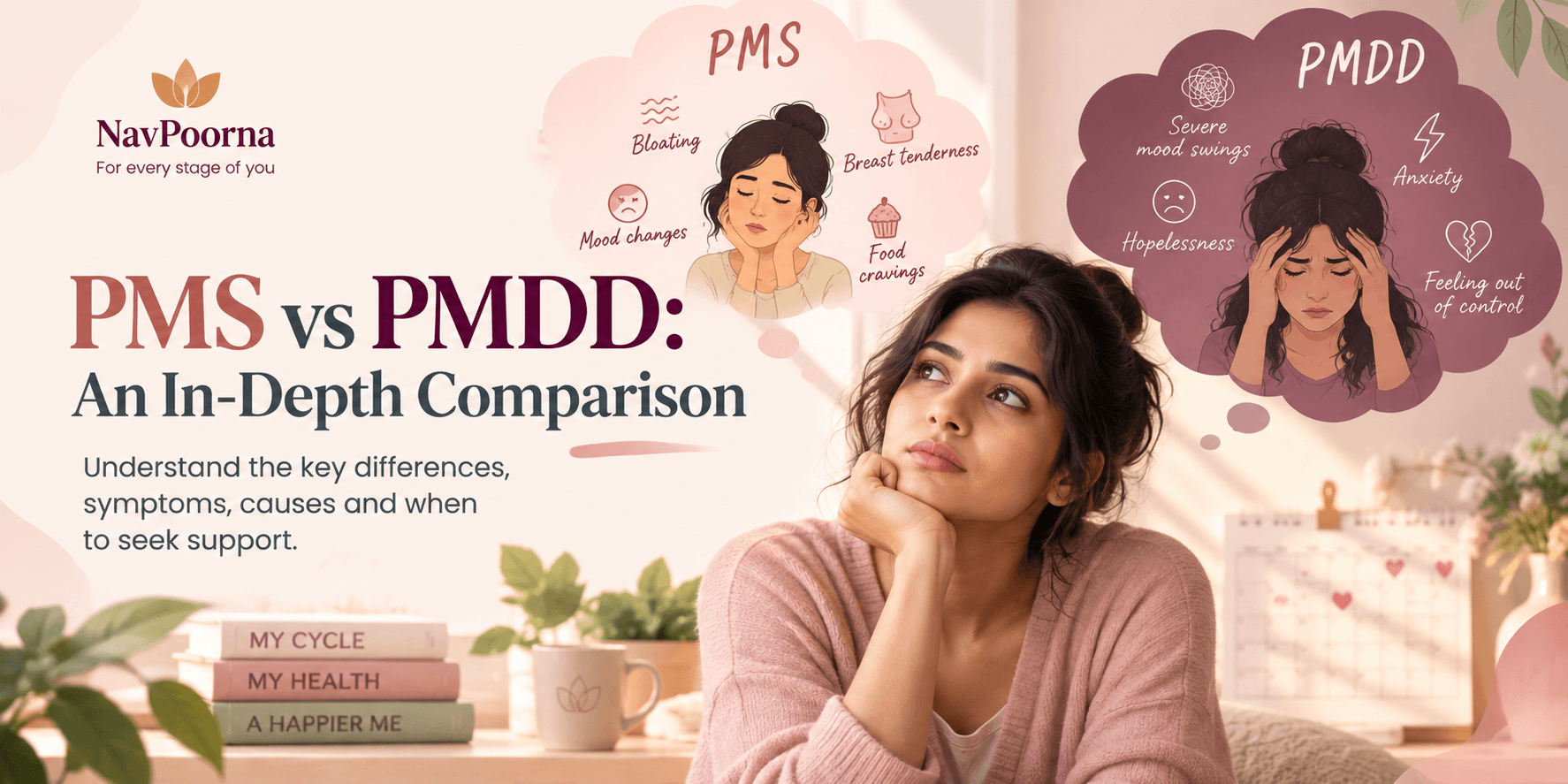
PMS vs PMDD: An In-Depth Comparison (Symptoms, Causes & Diagnosis)
Confused about PMS vs PMDD? Explore the real differences in symptoms, causes, and diagnosis, backed by medical research, to understand what you're truly experiencing.
Every month, the same question shows up in your mind right before your period: Is this just PMS, or is something more serious going on with me? If you've ever cried over a TV ad, snapped at someone you love, or felt like a completely different person for a week — only to feel "normal" again once your period starts — you're not alone, and you're not overreacting.
The truth is, PMS and PMDD often get lumped together as the same thing. They're not. One is a common, manageable monthly discomfort. The other is a recognised mental health condition that can quietly take over your life. Knowing the difference isn't just useful — it can change how seriously your symptoms are taken, both by your doctor and by yourself.
Key Takeaways
- PMS is common and usually manageable; PMDD is a diagnosable mental health condition affecting only 3–8% of menstruating people.
- PMDD requires at least 5 of 11 specific symptoms, including one core emotional symptom, confirmed through 2 cycles of tracking.
- Both conditions stem from the luteal phase, but PMDD reflects an unusually strong brain sensitivity to normal hormone changes — not abnormal hormone levels.
- Symptom tracking for at least two cycles is the most reliable way to tell the two apart and get an accurate diagnosis.
- If premenstrual symptoms are disrupting your life, it's worth a real conversation with a doctor — not something to simply endure every month.
What Is PMS, Really?
Premenstrual syndrome (PMS) is the collection of physical and emotional symptoms that show up in the two weeks before your period, during what's called the luteal phase of your cycle. According to the American College of Obstetricians and Gynecologists (ACOG), up to 90% of women experience at least one premenstrual symptom, while around 20–32% report symptoms severe enough to genuinely interfere with daily life.
Common PMS symptoms include bloating, breast tenderness, fatigue, mild irritability, food cravings, and low mood. They're uncomfortable, sometimes frustrating, but for most women, life still goes on. You might feel "off," but you can usually still show up to work, hold a conversation, and function through it.
What Is PMDD, and Why Is It Different?
Premenstrual dysphoric disorder (PMDD) is often described as PMS's more severe, more serious cousin — but that description undersells it. According to the American Psychological Association, PMDD is an officially recognised diagnosis in the DSM-5, the manual doctors use to diagnose mental health conditions. It affects an estimated 3 to 8% of menstruating people, and it doesn't just make you feel "off" — it can genuinely disrupt your relationships, your work, and in severe cases, has even been linked to a higher risk of self-harm.
PMDD symptoms are intensely emotional: rage that feels disproportionate, waves of hopelessness, panic, or a sense of being completely out of control of your own mind — all arriving like clockwork, then disappearing almost entirely once your period begins.
PMS vs PMDD: Side-by-Side Comparison
| Factor | PMS | PMDD |
|---|---|---|
| How common | Up to 90% experience some symptoms; 20–32% moderate-to-severe | 3–8% of menstruating people |
| Official diagnosis | No single formal diagnostic criteria | Yes — listed in the DSM-5 as a depressive disorder |
| Core symptoms | Bloating, fatigue, mild mood changes, cravings | Severe mood swings, rage, hopelessness, anxiety, feeling out of control |
| Impact on daily life | Uncomfortable but usually manageable | Can seriously disrupt work, relationships, and functioning |
| Number of symptoms needed | No formal minimum | At least 5 of 11 symptoms, including 1 core mood symptom |
| Timing | Luteal phase, eases when period starts | Same luteal-phase pattern, but confirmed only through 2 cycles of tracking |
| Underlying cause | Normal hormonal fluctuation | Brain's abnormal sensitivity to otherwise normal hormone levels |
The Science Behind Both Conditions
Here's something that surprises most people: women with PMDD usually have completely normal hormone levels. According to research highlighted by ClearHormones, the issue isn't how much estrogen or progesterone your body makes — it's how sensitively your brain reacts to the natural rise and fall of these hormones, particularly a progesterone byproduct called allopregnanolone, which affects mood-regulating brain chemicals. In simple terms: your hormones aren't "wrong." Your brain is just unusually reactive to their normal monthly changes — and that reaction is real, not imagined.
How Doctors Actually Diagnose PMDD
Because PMDD symptoms can look like anxiety, depression, or even bipolar disorder, doctors don't diagnose it from a single conversation. As explained by HealthPartners, diagnosis typically requires tracking your symptoms daily for at least two menstrual cycles. This confirms two things: that your symptoms strictly follow the luteal-phase pattern, and that they clear up almost completely once your period arrives. If symptoms persist all month long, it may point to another condition — like a thyroid issue or an existing mood disorder — rather than PMDD.
When to See a Doctor
If your premenstrual symptoms are making you dread an entire week of every month — affecting your work, your relationships, or your sense of self — that's not something to just "push through." A good starting point is keeping a simple daily symptom diary for two cycles, then bringing it to a gynaecologist or mental health professional. This single piece of tracked evidence often does more to get you taken seriously than describing your symptoms from memory ever could.
Frequently Asked Questions
PMS itself doesn't "become" PMDD, but symptom severity can change with age, stress, or hormonal shifts, which is why tracking your symptoms over time is useful even if you've been diagnosed with mild PMS before.
Yes. PMDD is officially classified as a depressive disorder in the DSM-5, the same diagnostic manual used for conditions like major depression and anxiety disorders.
For a formal diagnosis, symptoms need to occur in most menstrual cycles over about a year, following the same luteal-phase pattern each time.
For some women, certain hormonal contraceptives can help stabilise mood by reducing hormonal fluctuation, though response varies and this should be discussed with a doctor.
Track your symptoms daily for two menstrual cycles, noting mood, physical symptoms, and timing. This pattern is what doctors use to tell the two conditions apart.
Keep Reading
Two more reads from the Journal, thoughtfully chosen to continue from here.
 Periods
5 October 2026
White Discharge: What's Normal, What's Not & When to See a Doctor
Confused about white discharge? Learn what's normal, what colors and symptoms signal infection, and why this topic carries extra weight for Indian women.
Read more Periods
4 October 2026
Can Unmarried Women Use Menstrual Cups? Virginity Myth Busted
Worried a menstrual cup will affect your virginity? Learn the real hymen anatomy, why this myth persists in India, and how to safely use a cup for the first time.
Read more